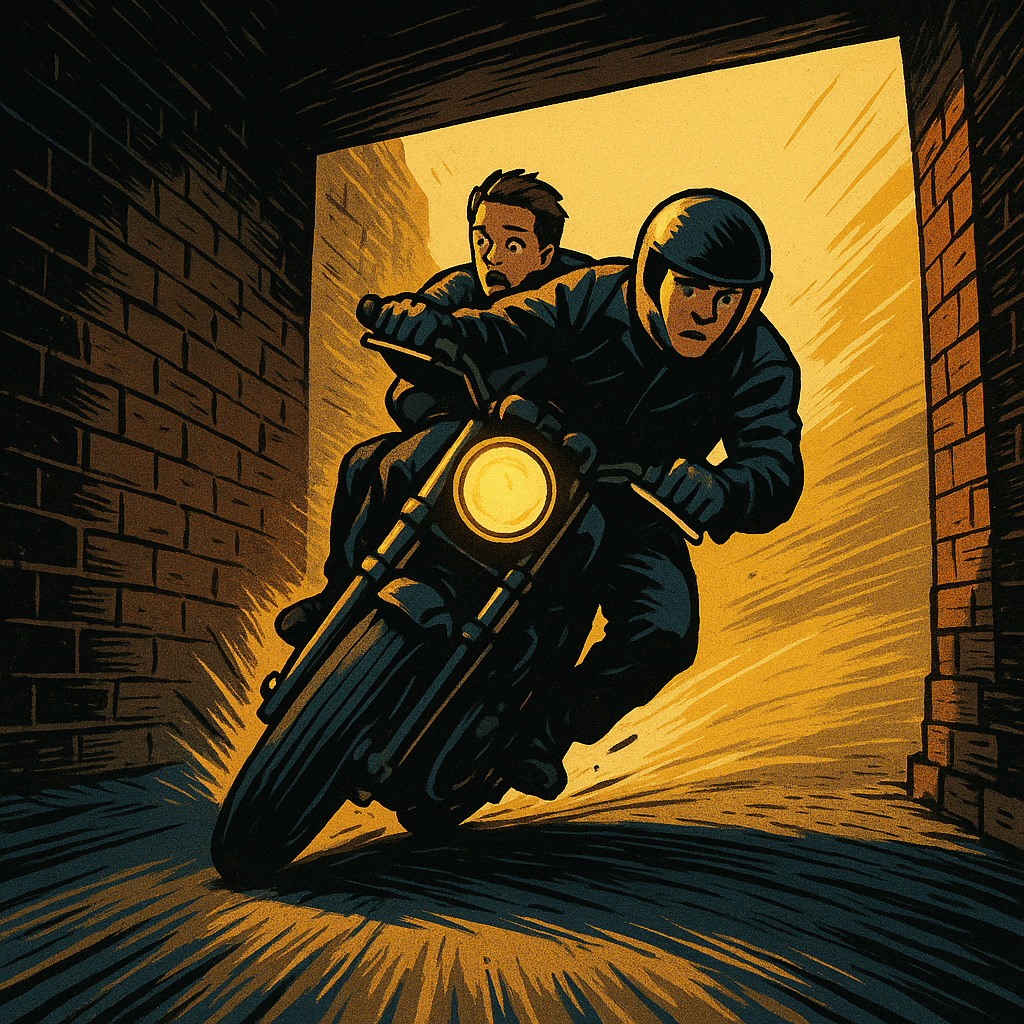
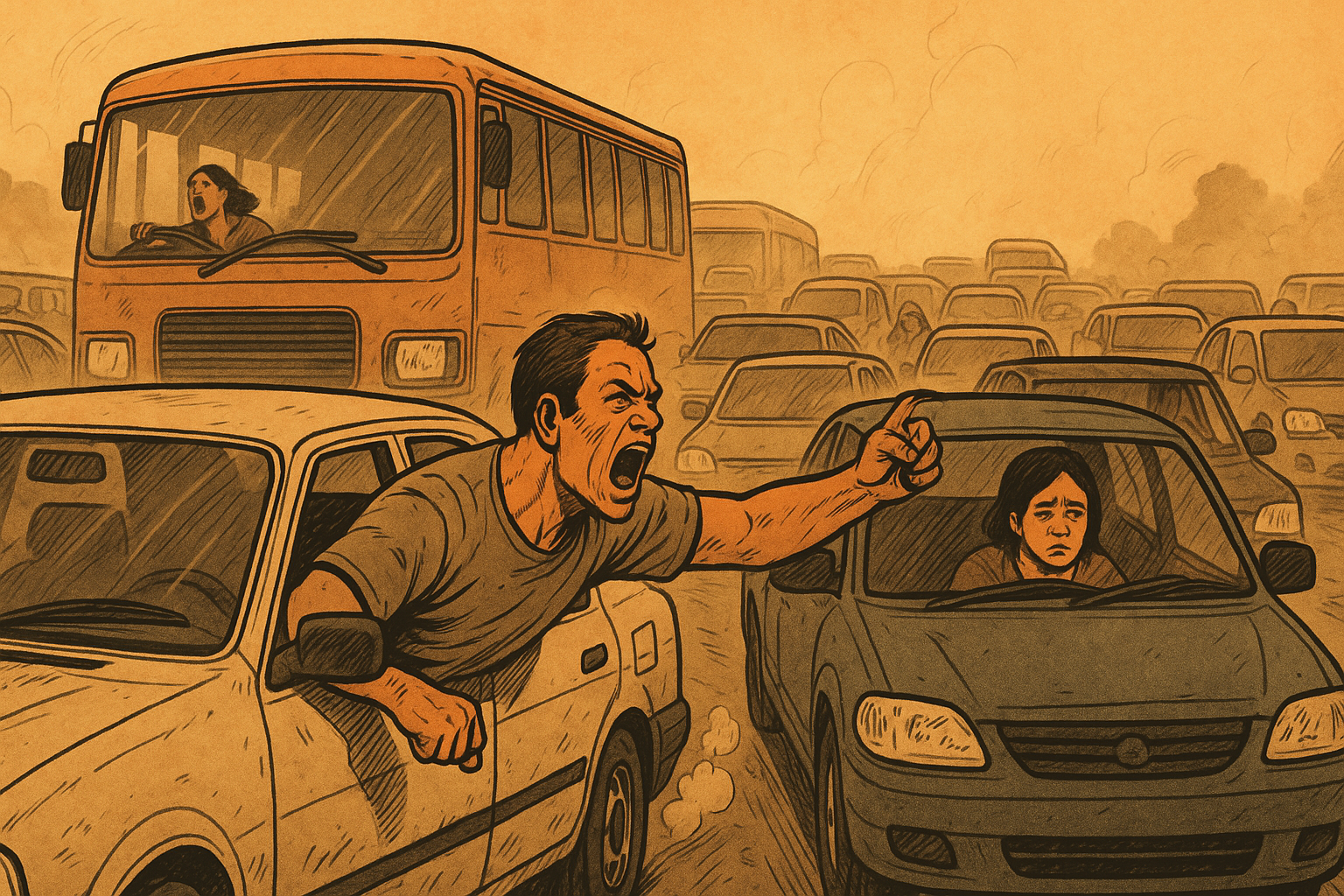
The streets of the old town were their typical, bustling selves. Sirish and Dawa found themselves weaving through the dense crowd urgently. The relentless drone of engines and blaring horns created an all-too-familiar cacophony, harmonizing with the persistent calls of street vendors hoping to lure in potential customers. Pedestrians hustled, jostling for space with impatient drivers who blared their horns without restraint.
“You ever wonder how these street vendors make ends meet?” Dawa mused, watching them experiment with tactics to catch the eye of passersby. “Do you think they earn enough to keep up with city life?”
Sirish glanced around. “They must be making something. We see them here every day, right? They’re getting by.” He paused, scanning the street. “Let’s cross over or we’ll get stuck here.”
Suddenly, the sharp wail of an emergency siren sliced through the noise, demanding space for a VIP sedan followed closely by a security truck. Inside, Minister Om was en route to the mayor’s office after a crucial meeting.
He gazed out through the tinted windows, adjusting his elegant sunglasses over a nose just a touch longer than most. His short, carefully groomed hair hinted at a quiet effort to keep what remained from slipping away. “It’s all in disarray,” he remarked, noting the vendors crowding the pavements, leaving little room for pedestrians. “These vendors don’t belong here; they’re impinging on people’s rights.”
The popular minister was believed to be more practical, un-detached from ground realities, unlike his counterparts. He had spent a lifetime observing these streets and, now with the authority to instigate change, he felt compelled to make a tangible difference.
“Sir, we’re on track to sort this mess soon. People have your back,” the personal assistant, a shifty middle-aged veteran, assured.
“Watch out!” Om’s shout was immediate as a boy unexpectedly dashed back onto the street.
Brakes screeched violently as the sedan veered sharply to the right, narrowly missing the boy. Tires shrieked against the asphalt as the driver regained control, surging forward. Behind them, the security pickup swerved wildly, barely avoiding a collision with the sedan before skidding to a halt in the oncoming lane.
Chaos erupted in the truck bed—security personnel shouted in panic, colliding into one another, their bodies slamming against the metal frame.
For a brief moment, the world stood still. The sudden stop sent a wave of gasps and startled screams rippling through the street, accompanied by the sharp scent of burnt rubber.
Elsewhere, Rammaya, an elderly fruit seller, answered a young girl’s inquiry. “The melons? One hundred per kilo.”
Before she could respond, the girl felt an intrusive hand on her butt. “Son of a bitch!” she exclaimed.
A half-hearted “Sorry” was thrown back, surprising in its very rarity. Yet, for Lalita and many other women, these unwanted advances had become a routine in the packed streets, with offenders ranging from grown men to even thirteen-year-olds.
The deafening sound of the VIP car’s brakes drew everyone’s gaze.
“Why the hell did he jump like that?” Lalita remarked, her eyes wide.
The boy’s face contorted in anger at the close shave. “Corrupt son of a bitch,” he yelled.
Without a second thought, he grabbed a chunk of broken pavement and hurled it at the speeding sedan. The impact sent a sharp crack through the air as the rear window shattered, splintering into a web of fractured glass.
Bystanders stood in stunned silence, their eyes locked onto the unfolding chaos, unable to process what had just happened. Then, from the far end of the street, a group of policemen came charging toward the boy, shouting and swearing.
The inspector’s eyes darted toward the security detail from the escorting SUV—one of them had already raised his rifle, finger hovering near the trigger. “No need to get excited, folks!” he bellowed. “I’ve got this.”
Before the boy could fully register what he had done, the policemen slammed him onto the asphalt. The impact knocked the air from his lungs as they twisted his arms behind his back, pinning him down with brute force.
The crowd stood transfixed, but a journalist spotted the makings of a compelling story. Gripping his camera tightly, he moved quickly to find the best angles, adjusting his lens with practiced precision. He crouched, zoomed, and snapped away, determined not to miss a single detail of the unfolding drama.
“That poor boy,” Rammaya whispered, her voice heavy with sorrow. “Just last week, right there,” she gestured somberly toward the spot, “a truck crushed someone.”
She let out a slow sigh, shaking her head. “But this… this will cost him.”
Within minutes, the commotion was quelled, the street was cleared, and the minister’s convoy, along with its security truck, sped off into the distance. Order had been restored—or so it seemed—but the air on the street felt heavier. Vendors cautiously returned to their spots, but the energy was subdued, the usual hustle muted by an undercurrent of anxiety.
The vendors exchanged uneasy glances, their murmurs weaving through the restless crowd, laced with doubt and suspicion.
“This doesn’t feel right,” muttered the bookseller, his fingers drumming anxiously against a stack of paperbacks. “Why would the minister take this road at this moment? And why would his car just happen to get attacked? It’s no coincidence.”
“You’re not wrong,” another vendor chimed in, setting his tray of bangles on a wooden crate with a deliberate thud. “For days now, people have been whispering that he’s planning to clear us out. This has to be a setup.”
“This all adds up,” said a man selling shirts. His brow knitted together as he absentmindedly rearranged the boxes. “They’re going to push us out. Just watch.”
There had been a rumor—it spoke of a quiet plan, whispered to have come from a very reliable source, to rid the city’s sidewalks of street vendors once and for all.
Some dismissed it as political theater, something that always surfaced before a big announcement or a shift in power. Others, more seasoned in the language of power, sensed something real behind the silence—something cold and calculated. Still, hope lingered. Maybe it was just talk. Maybe nothing would come of it.
But then came the incident.
It was brief—just a moment—but enough to shatter the illusion. The minister’s sudden visit, the sharp crackle of tension in the air, the chaos that followed, and the swift, clinical action of the police all unfolded with precision, as though rehearsed. In that moment, the rumor took shape. It was no longer a murmur in the background. It was real, loud, and unmistakable.